


Agent evaluation often relies on two approaches: code-based checks and LLM-as-a-judge.
Code based is fast, cheap, and dependable when the rules are clear. Did the agent call the required tool? Does the output match the schema? Did the transaction complete?
LLM judges handle questions that require interpretation, such as whether an answer follows a policy or addresses the user’s request. But they can be slower, more expensive, and inconsistent across repeated runs.
Jev offers a different interface: give it the state, ask predefined questions, and receive typed values directly. That makes agent evaluation one of its most interesting use cases.
What makes Jev different
TypeSafe AI’s Jev is what the company calls a “System One” model. It produces structured answers without generating free-form text token by token.
You provide context, such as an agent trace and retrieved evidence, along with specific questions. Jev returns answers in predefined formats that software can use directly.
Its API supports three question types:
Choice: Which failure category best explains this trace?
Score: How well did the agent satisfy a 1–5 groundedness rubric?
Binary check: Is the final answer supported by the retrieved evidence?
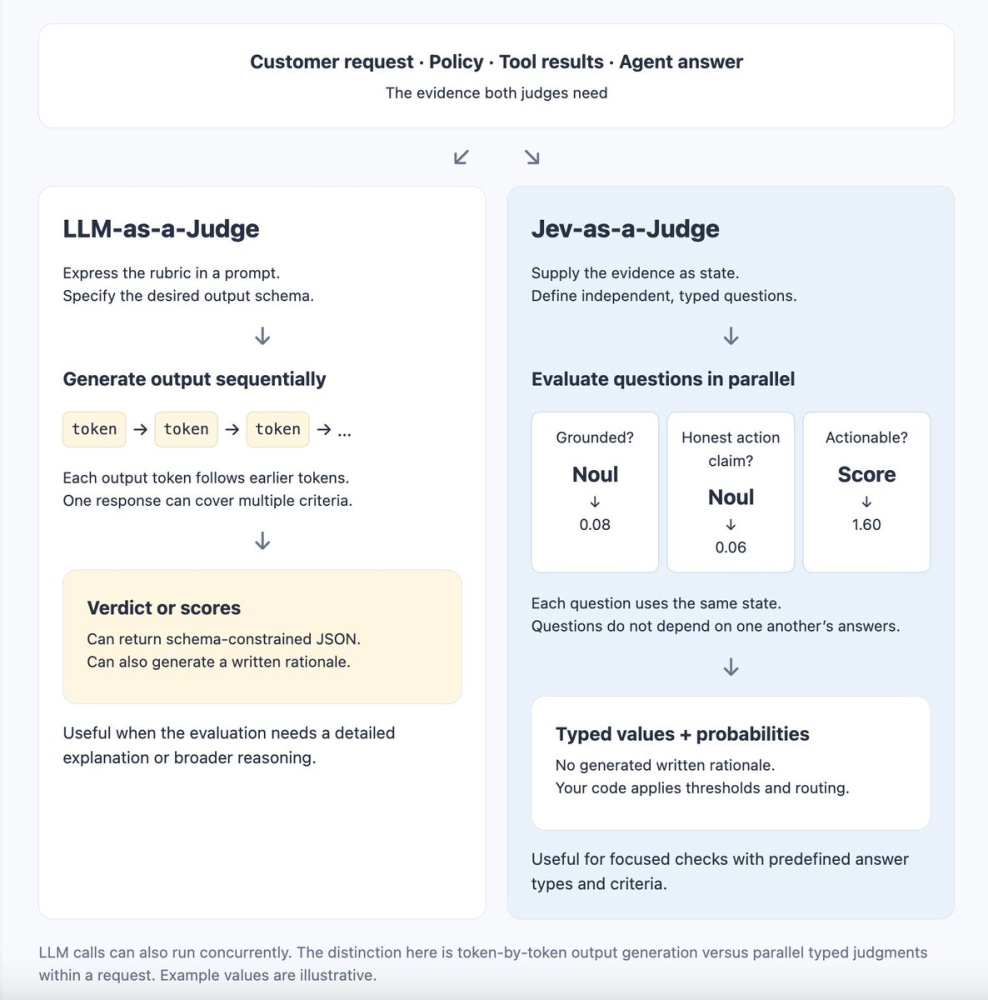
Multiple questions can be evaluated in parallel against the same context. TypeSafe says adding questions has little effect on response time, though teams should test this with their own workloads.
At launch, TypeSafe listed pricing at $0.042 per million input tokens, with no output-token charge. Actual evaluation cost still depends on how much context and how many questions you send.
Structured output makes a result easier to consume. It does not guarantee that the judgment is correct.
What the early results show
In a LangChain experiment, Jev was compared with GPT-5.6 Luna, GPT-5.6 Terra, and Claude Sonnet 4.6.
The test used five fixed weather-agent responses. Each judge evaluated every response 100 times.
Jev matched the human reviewer’s binary pass/fail labels in all 500 repeated judgments. It also showed substantially lower variation in continuous quality scores. Average latency was 0.44 seconds, and average cost was $0.00035 per evaluation call.
These are promising results, with an important limit: the experiment covered five unique examples. Repeating them helps measure consistency, but it does not establish accuracy across a broad range of tasks. A judge can also be consistently wrong.
Why this matters for production evaluation
Consider a support agent handling thousands of conversations each day. If semantic evaluation is expensive, a team may review only a small sample. That leaves gaps in its view of production quality.
A lower-cost evaluator could make it practical to check a larger share of conversations against focused criteria:
Is the answer grounded in the retrieved policy?
Was the chosen tool appropriate for the request?
Does the response address the customer’s problem?
Was escalation appropriate?
Which failure category best describes the run?
These questions produce more useful feedback than a single overall quality score. A team can distinguish a grounding problem from poor tool selection or a missed escalation, then investigate the relevant part of the agent.
My view is that this is where the opportunity lies: broader coverage could help teams detect regressions earlier and connect production failures to better tests. Human reviewers can focus on ambiguous or high-impact cases while also auditing routine judgments for mistakes.
Where Jev fits in an evaluation stack
I would use a layered approach, choosing each evaluator based on the question it needs to answer.
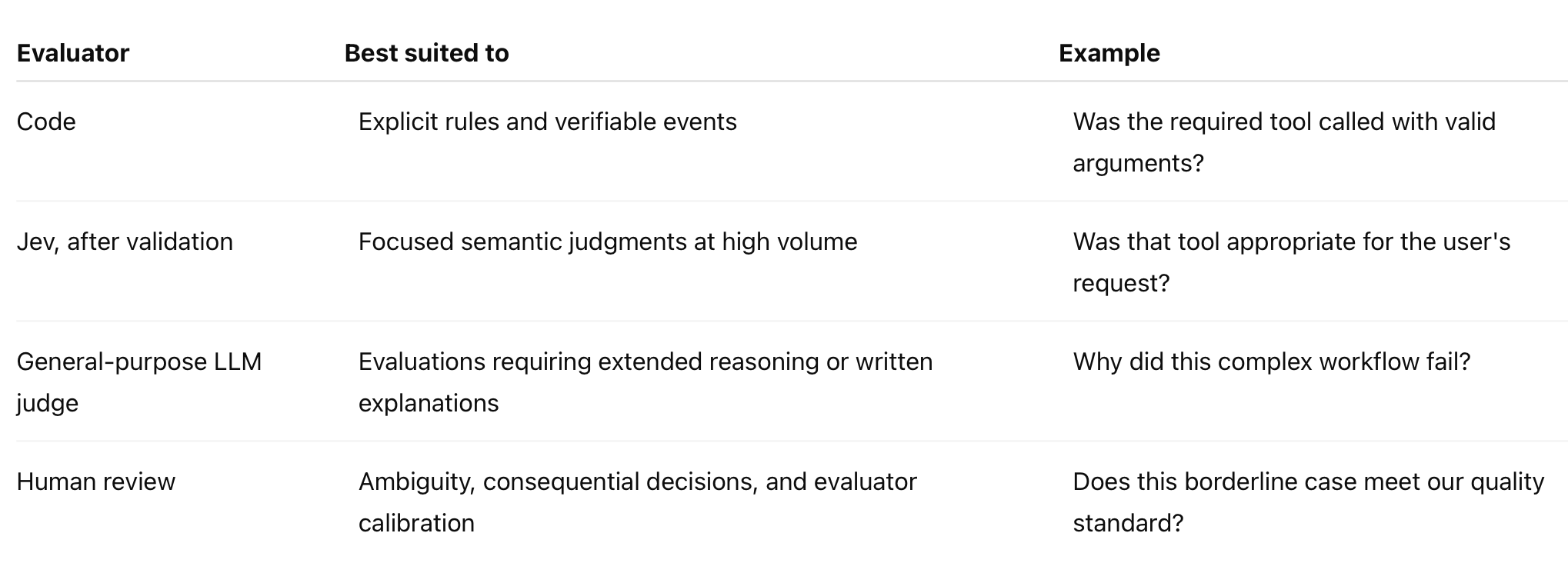
The distinction between tool execution and tool appropriateness matters. Code can verify that a call happened. Judging whether it was the right call may require understanding the request and surrounding context.
Where to start
Start with one narrow criterion, such as answer groundedness.
Build a human-reviewed dataset with clear passes, clear failures, and difficult borderline cases.
Compare Jev with your current judge, using the same evidence and rubric.
Measure agreement with human labels, repeatability, latency, and total evaluation cost.
Inspect disagreements, especially harmful answers that incorrectly pass.
Test whether confidence predicts correctness on your data before using it to route cases.
Expand coverage gradually, keeping human audits and escalation paths in place.
Jev is an early product, and its usefulness will depend on the task, rubric, and evidence available to it. Lower cost makes validation more valuable because a flawed judge can spread bad feedback across many more traces.
What interests me most is the possibility of turning more production traces into actionable feedback.
Teams will be able to investigate failures sooner, improve their test sets, and ship agent changes with greater confidence.
Given Jev was released just under a week ago, the amount of activity around it is extremely impressive.
Nice framing. I’d also freeze the exact evidence snapshot and allowed action set beside each verdict: in Jev Social, the same typed route can be correct at judgment time and still fail after browser state changes, so evaluator quality and executor-state drift need separate metrics.